
The political relationship between billionaire Elon Musk and US President Donald Trump could face a major test after the November midterm elections. Technology journalist Kara Swisher has warned that Musk may face renewed congressional scrutiny if Democrats regain control of Congress. Musk responded sharply, turning the discussion into another high-profile clash between Silicon Valley influence and Washington politics.
The Kara Swisher Elon Musk controversy is about more than a disagreement between two prominent figures. It raises important questions about political donations, government contracts, public accountability, and the influence that wealthy business leaders can exercise over government decisions.
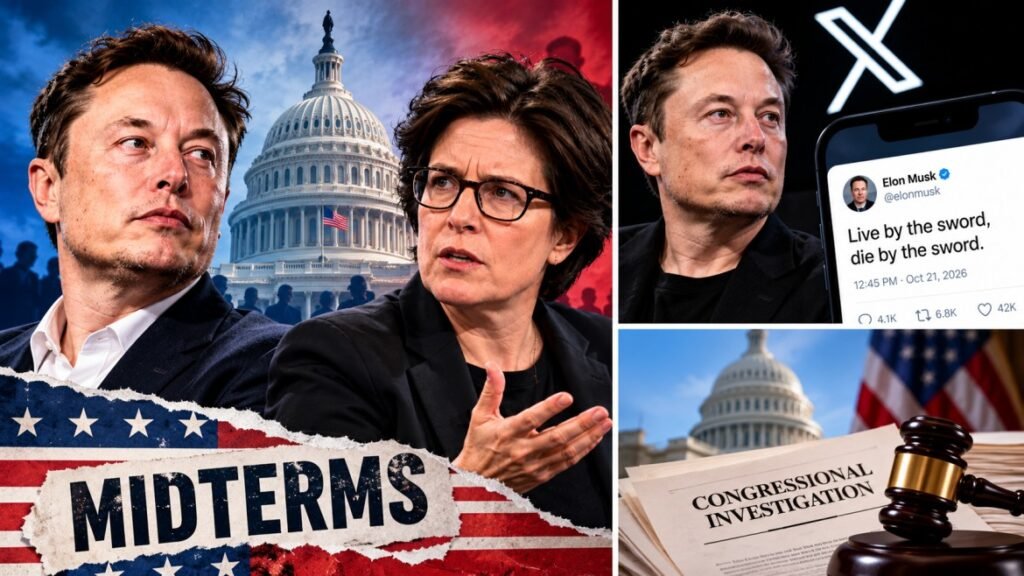
During an appearance on The Bulwark’s Receipts podcast, Swisher argued that Musk had benefited from his relationship with Trump and could face increased scrutiny if the balance of power in Congress changes. Musk responded on X with the pointed remark, “Live by the sword, die by the sword,” adding that Swisher appeared to want him to go to prison.
Here is what happened, why the midterm elections matter, and what a potential congressional investigation could actually mean.
The Setting: A Powder Keg in the Midterms
To understand the weight of Swisher’s warning, we have to rewind to the atmosphere of the 2022 U.S. Midterm elections. It was a period defined by anxiety over election denialism, misinformation, and the potential for real-world violence fueled by online rhetoric.
Enter Kara Swisher. As one of the most respected—and feared—voices in Silicon Valley, Swisher has built a career on holding the powerful accountable. She is the journalist who was rarely charmed by Steve Jobs, and she certainly isn’t charmed by Musk. Her warning was essentially a plea for sanity: a demand that the new owner of the world’s most important communication platform ensure that the midterms wouldn’t be derailed by a tidal wave of unmoderated lies.
Swisher’s warning wasn’t just about content moderation; it was about the responsibility of ownership. She implicitly asked the question many were thinking: Is Musk ready to handle the fallout if his “free speech absolutism” leads to chaos at the polls?
The Response: The “Trial by Combat” of Public Opinion
Musk’s response, as is his custom, came via the timeline. Rather than offering a dry, corporate press release or a detailed policy outline, Musk engaged in his signature style of erratic, meme-laden, and often combative tweeting.
The dynamic between the two is fascinating. Swisher represents the old guard of tech journalism—rigorous, principled, and skeptical. Musk represents the disruptor who has decided that the press is the enemy. When Swisher warned of the “red wave” of disinformation, Musk’s counter-position was essentially a refusal to accept the premise. He leaned into his narrative of “citizen journalism” and the idea that the “old media” (of which Swisher is a titan) was obsolete.
The Kara Swisher Elon Musk dynamic became a spectator sport. Observers watched as Musk doubled down on the idea that moderation is censorship. His response to warnings like Swisher’s was to publish the “Twitter Files,” effectively handing ammunition to those who believed the platform was previously biased against conservatives.
But here lies the unique insight: Musk’s response to Swisher wasn’t just defensive; it was an economic and philosophical restructuring. He wasn’t just saying, “I disagree.” He was saying, “Your way of doing things is over.”
Musk’s Political Spending Adds Another Dimension
Political donations are central to understanding why the dispute has attracted attention.
Reuters reported on October 12 that Musk had spent approximately $366 million during the 2026 US midterm election cycle, including about $276 million since July, largely supporting Republican-aligned groups.
The sums illustrate how one wealthy donor can exert substantial influence over campaign financing and electoral strategy.
Swisher’s analysis connects that spending to a broader political calculation: a donor with extensive business interests may have reasons to prefer a government whose policies and leadership align with those interests.
That interpretation should not be mistaken for proof of Musk’s private motives. Political contributions can reflect ideology, business priorities, personal loyalties, or a combination of factors.
The more concrete question is whether political relationships have affected government decisions in ways that warrant scrutiny.
How Did Elon Musk Respond to Kara Swisher?
Musk did not take Swisher’s warning quietly.
In response to her remarks, he posted on X: “Live by the sword, die by the sword. Sounds like Swisher really wants to go to prison.”
The response framed the controversy as a personal and political confrontation rather than a conventional exchange over congressional oversight.
Musk subsequently made a broader statement after reports emerged that Democratic lawmakers were considering investigations into his companies and activities. According to Fox Business, he warned that he would seek to identify and challenge the people behind efforts directed against him.
The broader message was clear: Musk intends to push back against political opponents who use congressional power to scrutinize his business interests.
However, a forceful social media response does not resolve the underlying questions. Whether an investigation is justified would depend on the evidence, the specific allegations, and the authority of the committee conducting it.
For readers following the story, the important question is not simply who won the online exchange. It is what the next Congress could legally examine.
A Personal Note on the “Digital Divide”
In researching this topic, I couldn’t help but reflect on how the Kara Swisher Elon Musk feud mirrors a larger trend in our personal digital consumption. We all have a bit of Swisher in us—wanting order, facts, and accountability. We all have a bit of Musk in us—wanting speed, freedom, and the ability to shout into the void without a babysitter telling us to calm down.
But when we are talking about elections, the stakes are too high for “move fast and break things.” Swisher’s warning was a plea for guardrails. Musk’s response was to remove the brakes and tell us to enjoy the ride. It was thrilling for many, terrifying for others, and profitable for him either way.
The New Reality: What This Means for the Future
The most profound takeaway from this exchange is the death of the “neutral platform.” The pretense is gone. Under Musk, X is a political entity with a political agenda, even if that agenda is simply “anti-establishment.”
Swisher’s role here is historic. She acted as the conscience of the industry, documenting the slow-motion collision between a billionaire’s whims and a democracy’s needs. Her warning was a signal flare. And while Musk survived the midterms without a cataclysmic failure, the trust deficit he created is the real damage.
The discourse between them highlighted that the “probe” isn’t just about one election. It’s a constant state of affairs. Every day on X is a midterm, every day is a test of the platform’s integrity.
Conclusion: The Past Meets the Future
Kara Swisher represents the era of accountability, where tech leaders were asked to explain themselves to the press. Elon Musk represents the era of transparency—or rather, the raw, unfiltered exposure of everything. Swisher wanted a moderated debate. Musk gave us a food fight.
In the end, Swisher’s warning to Musk wasn’t just about the midterms. It was a warning about the fragility of truth. Musk’s response was to show us how sturdy his version of the truth was—even if it looked, to the rest of us, like a funhouse mirror.
As we look to the future, the Kara Swisher Elon Musk rivalry serves as a reminder that the internet is not a self-cleaning oven. It requires effort, care, and, yes, moderation. Whether Musk agrees with that or not, he has proven that he is the one holding the oven mitts.