
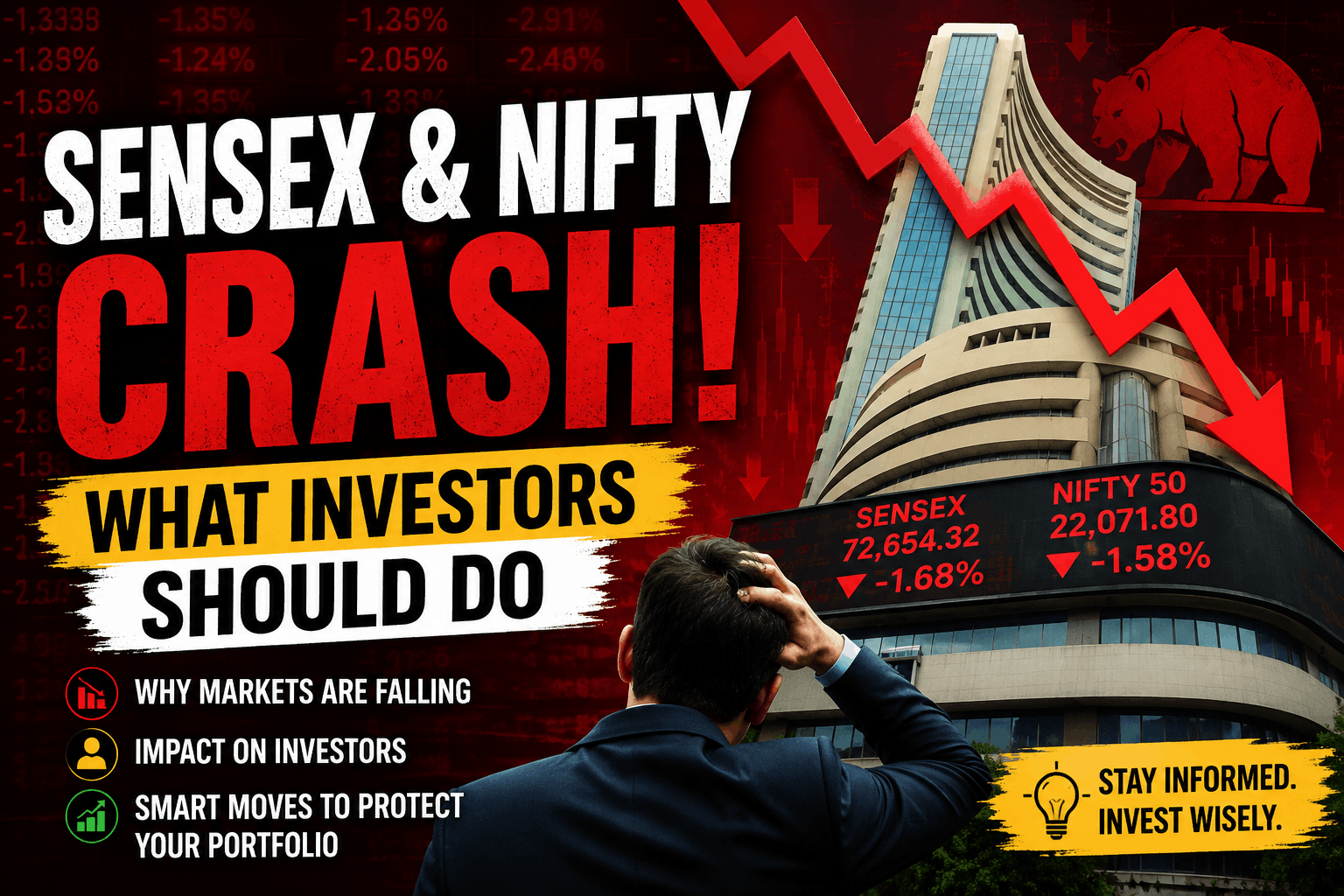
Sensex and Nifty Crash: What Investors Should Do (Beyond “Buy the Dip”)
The color red on your trading app can trigger a visceral reaction. Stomach knots. The urge to click “Sell All.” Just last week, as the Sensex tumbled over 1,200 points and the Nifty breached its critical support level of 22,800, my phone buzzed with the same question from a dozen friends: “Should I exit?”
If you are scrambling to understand why Sensex is falling today, you are not alone. But here is the uncomfortable truth most finance influencers won’t tell you: Doing nothing is often the most profitable action.
Let’s move past the generic “stay calm, invest for the long term” advice. We need a surgical playbook for the current volatility. Based on recent data from the Reserve Bank of India (RBI) and global trends, here is exactly what is happening and how to use this crash to build wealth.
Why Sensex is Falling Today: The Perfect Storm
To navigate a crash, you must diagnose the virus, not just treat the fever. As of early May 2026, the Indian market isn’t crashing due to a single black swan event, but a “Perfect Storm” of three distinct pressures:
1. The Global Tariff Hangover
Geopolitical tensions remain the elephant in the room. Recent fluctuations in US trade policies regarding Asian outsourcing hubs have triggered risk-off sentiment. Foreign Institutional Investors (FIIs) pulled out approximately ₹25,000 crore in April alone, seeking safety in US treasuries.
2. The Valuation Reset
We were flying too close to the sun. For months, the Nifty was trading at a Price-to-Earnings (P/E) ratio of over 24x, well above its historical average of 20x. This crash is not a disaster; it is a valuation correction. Stocks were expensive; now they are on sale.
3. Domestic Liquidity Crunch
Contrary to popular belief, the RBI’s tight grip on inflation (maintaining the repo rate at 6.5% to cool core inflation) has squeezed discretionary spending. Quarterly results from consumer goods giants like Hindustan Unilever and Tata Motors showed rural demand is still patchy.
“Markets are a device for transferring money from the impatient to the patient.” — Warren Buffett. Never has this felt more relevant than today.
Historical Comparison: Is this 2020 or 2013?
To gain perspective, we need a time machine. How does this crash compare to previous ones? The table below reframes the “panic” into perspective.
| Scenario | Nifty Drop | Recovery Time | Key Driver |
|---|---|---|---|
| Covid Crash (2020) | -38% | ~6 Months | Health Emergency (V-Shaped recovery due to liquidity) |
| Taper Tantrum (2013) | -15% | ~9 Months | Currency volatility & Rate hikes (Slow grind) |
| Current Situation (2026) | -8% (so far) | Unknown | Valuation correction + Global Tariffs |
Fresh Perspective: This is not Covid. In 2020, we had no income; today, we have high income but high inflation. Therefore, a U-shaped recovery (slow and steady) is more likely than a V-shaped one. You have time to accumulate.
Sensex Crash vs Previous Market Crashes
Here’s something experienced investors understand:
Every crash feels unique while it’s happening.
But most market corrections follow similar emotional patterns.
| Market Crash | Trigger | Investor Emotion | Recovery Outcome |
|---|---|---|---|
| 2008 Financial Crisis | Global banking collapse | Extreme fear | Strong multi-year bull market |
| 2020 COVID Crash | Pandemic uncertainty | Panic selling | Historic recovery |
| 2022 Inflation Sell-off | Rising interest rates | Caution | Gradual rebound |
| Current Crash | Oil prices, geopolitics, FII selling | Anxiety | Still unfolding |
The lesson?
Crashes are temporary.
Investor behavior is permanent.
The Biggest Mistakes Investors Make During Market Crashes
1. Selling Quality Stocks in Panic
This is the classic mistake.
During sharp falls, investors start selling good businesses simply because prices are falling.
But price decline alone does not mean business deterioration.
A stock falling 20% does not automatically make the company weak.
Often, crashes create discounts in fundamentally strong companies.
2. Checking Portfolios Every Hour
This increases emotional decision-making.
Market crashes create a psychological loop:
- Prices fall
- Fear rises
- Investors check apps more often
- Anxiety increases
- More panic selling happens
Sometimes the best investing decision is simply doing nothing.
3. Investing Without a Cash Buffer
One painful reality of market crashes:
The best opportunities appear when investors run out of cash.
This is why experienced investors always maintain some liquidity.
Not because they can predict crashes.
But because corrections are inevitable.
4. Averaging Down Bad Businesses
Not every falling stock is a bargain.
Some companies deserve to fall.
Investors often confuse:
- Cheap valuation nwith
- Good business quality
That’s a dangerous mistake.
Focus on:
- Strong balance sheets
- Consistent cash flow
- Competitive advantage
- Reasonable debt
- Long-term growth visibility
What Smart Investors Should Do Right Now
1. Revisit Asset Allocation
A crash reveals whether your portfolio matches your risk tolerance.
If a 10% decline is causing sleepless nights, your equity allocation may be too aggressive.
A balanced portfolio typically includes:
| Asset Class | Suggested Role |
| Equity | Long-term growth |
| Debt | Stability and liquidity |
| Gold | Hedge against uncertainty |
| Emergency Fund | Financial protection |
Asset allocation matters more than stock prediction.
2. Continue SIPs During Corrections
This is where discipline beats intelligence.
Most investors love SIPs during bull markets.
But the real magic of SIP investing happens during market declines.
Lower prices allow investors to accumulate more units.
Historically, investors who continued SIPs during crashes often generated superior long-term returns.
3. Focus on Earnings, Not Headlines
Financial media thrives during crashes.
Headlines become dramatic because fear attracts attention.
But long-term investing success depends more on business earnings than daily news cycles.
Instead of obsessing over index movements, ask:
- Is the company still growing?
- Is demand intact?
- Is management credible?
- Is debt manageable?
Good businesses usually survive temporary panic.
4. Create a Watchlist of Quality Stocks
Market corrections are often the best time to prepare future investments.
Build a watchlist of:
- Market leaders
- Strong brands
- Consistent compounders
- Businesses with pricing power
When fear peaks, opportunities emerge.
5. Avoid Leveraged Trading
This is not the environment for reckless F&O speculation.
Volatility destroys leveraged traders quickly.
Many retail investors lose significant capital trying to “recover losses fast” during crashes.
Protecting capital should be the first priority.
Is This a Good Time to Invest?
This depends on your investment horizon.
If You’re a Long-Term Investor
Corrections can be opportunities.
India’s long-term growth story remains supported by:
- Rising consumption
- Manufacturing growth
- Digital adoption
- Infrastructure spending
- Demographic advantage
Temporary crashes do not erase structural growth.
If You Need Money Soon
Be cautious.
Money needed within 1–3 years should ideally not be heavily exposed to equities.
Short-term market direction is unpredictable.
A Personal Lesson Every Investor Eventually Learns
Most people think investing is about finding multibagger stocks.
In reality, successful investing is mostly about emotional control.
During bull markets, everyone feels like a genius.
During crashes, discipline becomes rare.
The investors who build real wealth are usually not the smartest.
They are the ones who:
- Stay calm during panic
- Avoid emotional decisions
- Continue investing consistently
- Think in decades, not days
That mindset matters far more than predicting market bottoms.
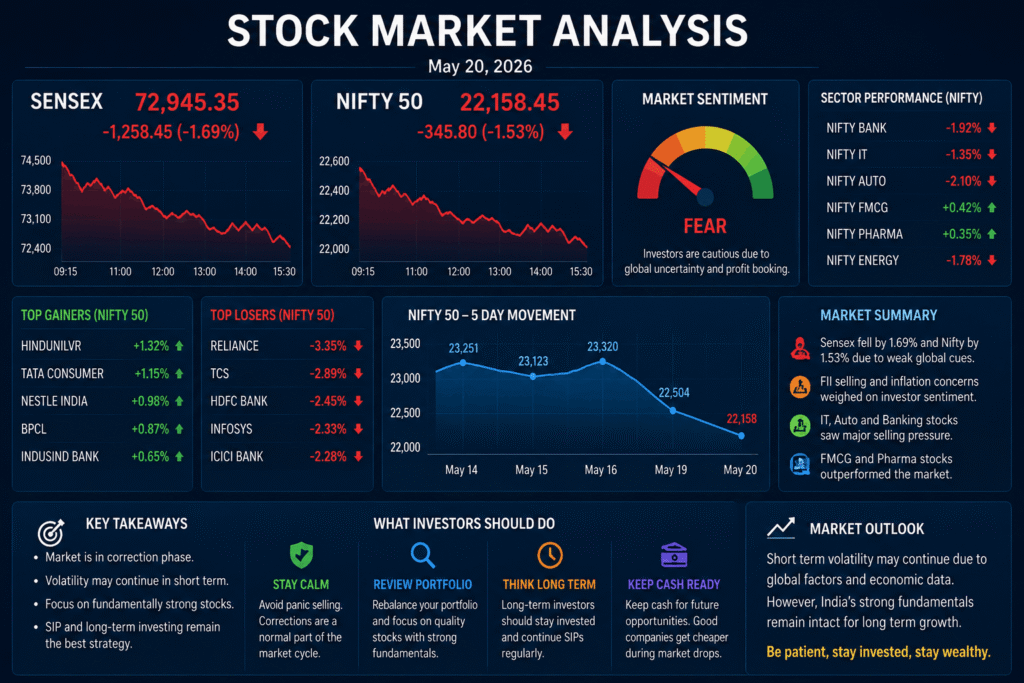
Key Takeaways: Why Sensex Is Falling Today and What Investors Should Do
Here’s a quick summary:
| Problem | Smart Investor Response |
| Rising oil prices | Avoid panic selling |
| FII outflows | Focus on long-term fundamentals |
| Market volatility | Continue disciplined SIPs |
| Weak rupee | Diversify intelligently |
| Fear-driven selling | Maintain cash reserves |
The market may continue to remain volatile in the near term.
But volatility is not the enemy.
The Bottom Line
Understanding why Sensex is falling today is crucial—it’s a mix of global tariff fears, high valuations, and liquidity tightening. But knowing what to do is priceless.
Stop looking for the exact bottom. Instead, focus on asset allocation. The best investors aren’t the ones who never see red; they are the ones who, when the screen turns red, stick to the process.
Call to Action:
Have you already pressed the panic button, or are you holding steady? Drop your biggest portfolio worry in the comments below. Let’s discuss whether your specific stock is a “buy” or a “bye.”
Disclaimer: This is for educational purposes only. Consult your financial advisor before making any investment decisions.