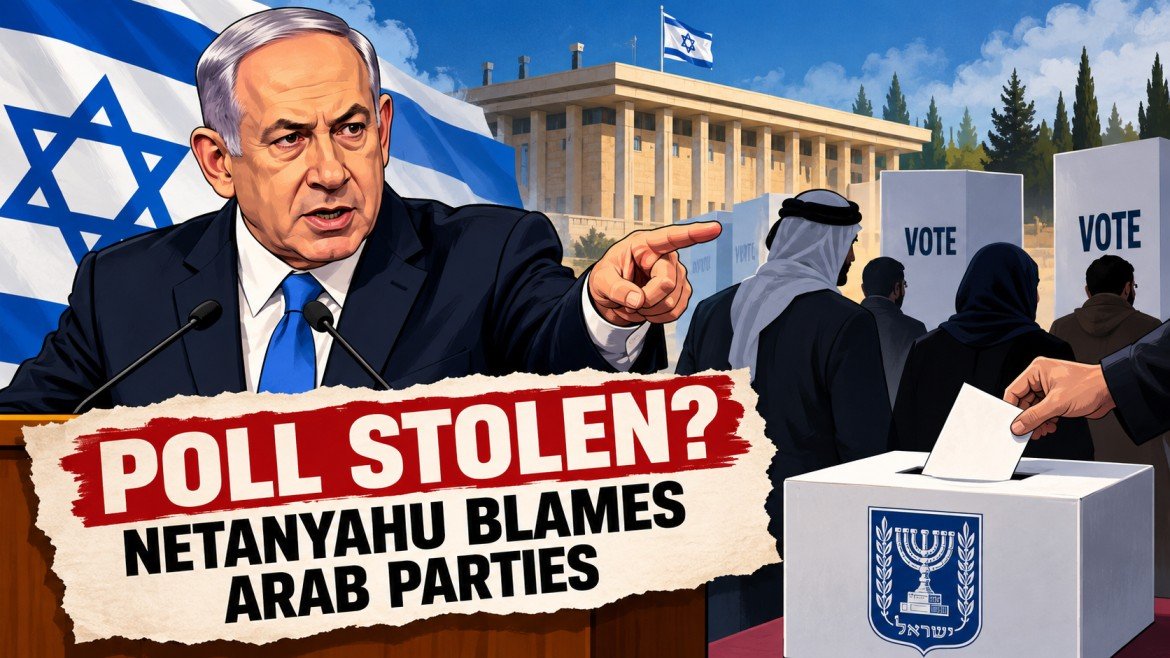
The “Netanyahu Arab parties poll stolen” controversy has intensified Israel’s political uncertainty following the country’s October 27, 2026, parliamentary election. Prime Minister Benjamin Netanyahu’s Likud party accused Arab-led political parties of election fraud, alleging bribery, voter intimidation and other irregularities. The accusations came after preliminary results indicated that Arab-led parties had secured a historic level of parliamentary representation, potentially influencing which political bloc could form the next government. However, the allegations have not established that the election was stolen. On October 29, a report by Anadolu Agency, citing Israeli media, said police had found no evidence supporting Likud’s broader fraud claims. Israel’s Central Elections Committee has confirmed that it is reviewing the complaint as part of its election-integrity procedures. The dispute now raises questions about democratic accountability, Arab political representation and the formation of Israel’s next government. AP News+1
What Happened in Israel’s Election?
Israel held its parliamentary election on October 27, 2026, with competing political blocs seeking the 61 seats required for a majority in the 120-member Knesset, Israel’s parliament.
Preliminary results reported on October 28 placed Netanyahu’s right-wing and religious bloc at approximately 53 seats. The bloc associated with his principal challenger, former military chief Gadi Eisenkot, was projected to win 48 seats, while Arab-led parties were forecast to secure 19 seats collectively.
These figures were provisional, with additional ballots still to be counted. Nevertheless, they indicated that neither of the two main political alignments could independently secure a parliamentary majority. AP News+1
The strong performance by Arab-led parties, including Ra’am and the Joint List, became a central issue in the post-election dispute.
On October 28, Likud claimed that Arab parties had effectively stolen the election and demanded investigations by the Israel Police, the Shin Bet domestic security agency and the Central Elections Committee.
The party alleged that serious criminal offences had affected voting in Arab communities. The allegations included bribery, threats, violence, falsification and the use of prohibited software to mobilise voters.
However, claims made by a political party must be distinguished from independently established findings. At the time of the initial accusations, Likud had not publicly established that coordinated fraud had altered the election results. The Times of Israel
What Are Netanyahu’s Arab Parties Poll Stolen Allegations?
The phrase Netanyahu Arab parties poll stolen describes a controversy over allegations that Arab-led parties improperly influenced Israel’s election.
Likud said it was submitting hundreds of testimonies and other material to the relevant authorities. According to the party, the evidence included allegations involving cash-filled envelopes associated with Ra’am ballot slips, intimidation of polling-station committee members, multiple people entering voting booths together, duplicate voting and discrepancies between the number of ballot envelopes and registered voters.
The party also alleged that prohibited software had been used to mobilise voters.
These are serious accusations because electoral integrity depends on citizens being able to cast their ballots freely and on votes being counted accurately.
However, the allegations remained allegations. The public reporting available on October 29 did not establish that these incidents formed part of a coordinated operation that changed the election outcome. AA+1
Likud demands a formal investigation
Likud called for a thorough investigation and sought action from several authorities.
The Israel Police is responsible for investigating suspected criminal offences, while the Shin Bet has domestic security responsibilities. The Central Elections Committee oversees the electoral process and examines complaints relating to election integrity and possible errors in results.
The committee confirmed that it had received Likud’s submission and was examining it under its regular election-integrity monitoring procedure.
According to The Times of Israel, the committee had informed participating electoral lists before election day that they could submit details of polling stations whose results they believed required additional examination.
That process is significant because reviewing a complaint is not the same as confirming the allegations contained in it. The Times of Israel
What Do Police and Election Officials Say About the Allegations?
The latest reporting available on October 29 adds an important qualification to Likud’s claims.
Anadolu Agency reported on October 29, citing Israeli newspaper Israel Hayom, that police had found no evidence supporting Likud’s broader election-fraud allegations. The report also said the Central Elections Committee saw no current grounds for concern about the overall integrity of the vote.
These developments do not mean every individual complaint has necessarily been resolved. Nor do they replace a final official investigation finding. They do, however, make it essential to distinguish the party’s accusations from evidence independently supporting them.
The Central Elections Committee’s confirmed public position was that it had received Likud’s complaint and was reviewing it through its standard procedures.
Separately, the Associated Press reported that the committee’s acting director-general, Dean Livne, said reports of polling-station irregularities or problems were substantially fewer than in previous elections. AP News+1
A separate vote-buying case adds context
There was also a reported investigation into suspected vote-buying involving Ra’am during the election campaign.
According to an AFP report published by Arab News on October 27, police confirmed that three people had been arrested on suspicion of attempting to buy votes for Ra’am. Police said investigators seized more than 24,000 Israeli shekels in cash, along with prepared envelopes and notes, during searches of suspects’ homes.
The same report said Dean Livne described the incident as localised rather than evidence of widespread manipulation across the country. The suspected offenders were reportedly apprehended near their homes, not at polling stations. The investigation remained a separate matter from the broader allegations that the election had been stolen. Arab News
This distinction is crucial. An alleged attempt to buy votes, if established, is a serious matter. But a specific criminal investigation does not automatically substantiate claims of systematic fraud by an entire political group or prove that the national result was manipulated.
Why Did Arab-Led Parties Become So Important?
The political significance of the accusations lies partly in the number of seats Arab-led parties were projected to win.
Ra’am, also known as the United Arab List, and the Joint List are distinct political organisations representing predominantly Arab constituencies. Their combined projected total of 19 seats would give them a potentially influential position in the 120-member Knesset.
Under the preliminary figures reported on October 28, Netanyahu’s bloc was projected to hold 53 seats, eight short of the 61 required for a majority. Eisenkot’s bloc was projected to hold 48 seats, also below the threshold.
The Arab-led parties therefore became central to discussions about alternative governing arrangements. However, their combined seats do not automatically translate into support for a single coalition. Parties must negotiate over policies, leadership and the terms of any potential agreement. The Times of Israel+1
Coalition negotiations could determine the next government
Israel follows a parliamentary system in which political parties win seats and then negotiate to form a government capable of commanding a parliamentary majority.
The leader of the largest party does not automatically acquire an unconditional right to govern. Coalition support and the process for selecting a candidate to form a government are important parts of the system.
With Netanyahu’s bloc short of a majority, the opposition could seek an alternative arrangement. But cooperation between Jewish-led opposition parties and Arab-led parties is politically contentious, and some opposition groups have rejected such a partnership.
Joint List chairman Yousef Jabareen said his party was willing to discuss cooperation with an opposition-led government but did not envisage joining a coalition under the prevailing circumstances. He cited disagreements over the Gaza war, West Bank settlements and other political issues. The Times of Israel+1
Consequently, the election is not simply a contest over who wins the most votes. It is also a struggle over which alliances can command sufficient parliamentary support.
Netanyahu’s Campaign Rhetoric and the Political Fallout
The election dispute emerged against a backdrop of sharply contested political messaging.
Before voting ended, Netanyahu urged his supporters to turn out, warning against leaving the country’s future in the hands of left-wing and Arab political groups. His comments portrayed the election as a consequential contest over Israel’s future direction.
On election day, he also accused Arab politicians of trying to steal the election, referring to the reported vote-buying investigation involving people suspected of attempting to buy support for Ra’am.
The following day, Likud escalated the dispute by alleging broader election fraud and requesting investigations by law enforcement and electoral authorities. Arab News+1
These developments have prompted concerns about political rhetoric and public confidence in elections.
Election-related complaints are a legitimate feature of democratic accountability when supported by specific evidence and handled through established procedures. At the same time, sweeping claims of a stolen election can undermine public confidence when the available evidence does not substantiate them.
For this reason, the distinction between political statements, documented irregularities and verified findings is especially important.
A credible assessment must consider the evidence presented by the complainant, the response of the relevant authorities and whether any proven irregularities were significant enough to affect the final result.
Neither a party’s allegation nor the absence of a final investigation outcome should be treated as conclusive proof of electoral wrongdoing.
What Happens Next in Israel’s Political Crisis?
The immediate priority is to complete the counting process and determine the final distribution of seats.
On October 28, the results remained provisional. Reports indicated that most ordinary ballots had been counted, but additional ballots, including double-envelope votes, were still pending. These ballots could affect the final allocation of seats. The Times of Israel+1
The next major step will be the formation of a government.
President Isaac Herzog has a role in the process of selecting a candidate to attempt to form a coalition. The Associated Press reported that he intended to consult the political factions after receiving the official results and urged leaders to approach the process with an open mind to avoid another election. AP News
Three developments will be particularly important:
- The final vote count: The confirmed seat distribution will establish how far each political alignment is from a majority.
- The outcome of electoral complaints: Authorities will need to assess the evidence and determine whether any alleged irregularities warrant further action.
- Coalition negotiations: Political parties will have to decide whether they can reach an agreement on leadership and policy.
The results of these processes will determine whether Netanyahu can assemble a government or whether his opponents can negotiate an alternative.
The election-fraud dispute may influence political negotiations, but its effect will depend on what the investigations and final results establish, not solely on the strength of public accusations.
Why This Matters
The dispute has implications beyond the immediate contest between Netanyahu and his political rivals.
First, it concerns public trust. Confidence in democratic elections depends on credible counting procedures, transparent complaints processes and evidence-based investigations. Allegations involving voting irregularities must be addressed seriously without treating unverified claims as established facts.
Second, the controversy highlights the role of Arab citizens and their political representatives in Israel’s parliamentary system. The strong projected performance of Arab-led parties gave them greater potential influence over coalition formation. The political response to that result will affect the debate over minority representation and participation in national decision-making.
Third, the absence of a clear majority creates uncertainty about the next government’s composition and priorities. Coalition negotiations could affect domestic policy, relations between political communities and Israel’s approach to regional security issues.
For international readers, the central issue is therefore not simply whether Netanyahu or his opponents emerge ahead. It is whether electoral complaints are handled transparently and whether the political system can produce a government with sufficient parliamentary support.
The coming days should help clarify the final vote totals and the prospects for coalition formation. Until the relevant authorities establish more facts, the allegations of a stolen election should remain clearly identified as allegations.
Frequently Asked Questions (FAQs)
1. Why did Netanyahu’s Likud party claim that Arab parties stole the election?
Likud alleged that bribery, intimidation, violence, falsification and prohibited voter-mobilisation software had affected the election. The party said it was submitting testimonies and other material to the police, the Shin Bet and the Central Elections Committee. The broader allegations had not been independently established in the reporting available on October 29, 2026. The Times of Israel
2. Has Israel confirmed that Arab parties committed widespread election fraud?
No. As of October 29, the Central Elections Committee had confirmed that it was reviewing Likud’s complaint. Separately, Anadolu Agency reported, citing Israel Hayom, that police had found no evidence supporting Likud’s broader allegations. A final determination of the complaints should not be assumed. AA
3. How many seats did Arab-led parties win in Israel’s 2026 election?
Preliminary projections published on October 28 indicated that Arab-led parties could secure 19 seats in the 120-member Knesset, a historic high according to contemporary reporting. The figures were provisional while additional ballots were being counted. AP News+1
4. Who is Gadi Eisenkot, and why is he important in the election?
Gadi Eisenkot is a former Israeli military chief and Netanyahu’s principal challenger in the reported election. His political bloc was projected to hold 48 seats in the preliminary count, leaving it short of the 61 seats needed for a parliamentary majority. Negotiations with other parties could determine whether an alternative government can be formed. AP News
5. What happens if no party or bloc wins a parliamentary majority?
Political parties must negotiate to form a coalition that can command a majority in the Knesset. Israel’s president plays a role in selecting a candidate to attempt to form the government. If political negotiations fail, the country could face continued political uncertainty and potentially another election. AP News+1
6. When will Israel’s election-fraud allegations be resolved?
There was no confirmed final resolution in the reporting available on October 29, 2026. The Central Elections Committee had acknowledged the complaint and said it was reviewing election-integrity submissions. The timing of any further investigative findings or decisions on individual complaints had not been established. The Times of Israel+1
Conclusion
The Netanyahu Arab parties poll-stolen controversy has added another layer of uncertainty to Israel’s post-election political crisis. Likud has accused Arab-led parties of manipulating the vote, but those allegations must be distinguished from verified evidence. Reporting available on October 29 indicated that police had found no evidence supporting the party’s broader fraud claims, while the Central Elections Committee continued its review.
Meanwhile, preliminary results showed Netanyahu’s bloc falling short of a parliamentary majority and Arab-led parties gaining unprecedented potential influence over coalition negotiations.
The next steps are clear: complete the vote count, assess election complaints through the appropriate procedures and determine which political alignment can form a government. The credibility of that process will matter as much as the political outcome.